If you are interested in learning how to become an HR manager in Nigeria, there are several pathways you can take. Human Resources (HR) managers play an important role in recruitment, employee relations, performance management, workplace policies, training and organisational development.
Becoming an HR manager usually requires more than simply obtaining an HR qualification. Employers commonly look for a combination of education, practical HR experience, communication skills, leadership ability and knowledge of employment practices.
This guide explains the typical career path, qualifications, skills and steps you can take to work towards an HR management position in Nigeria.
What Does an HR Manager Do?
An HR manager is responsible for overseeing important people-related functions within an organisation.
Depending on the size and structure of the organisation, an HR manager may be responsible for:
In smaller organisations, one HR manager may oversee many of these functions. In larger organisations, HR responsibilities may be divided between specialists, HR business partners, recruiters and other HR professionals.

How to Become an HR Manager in Nigeria
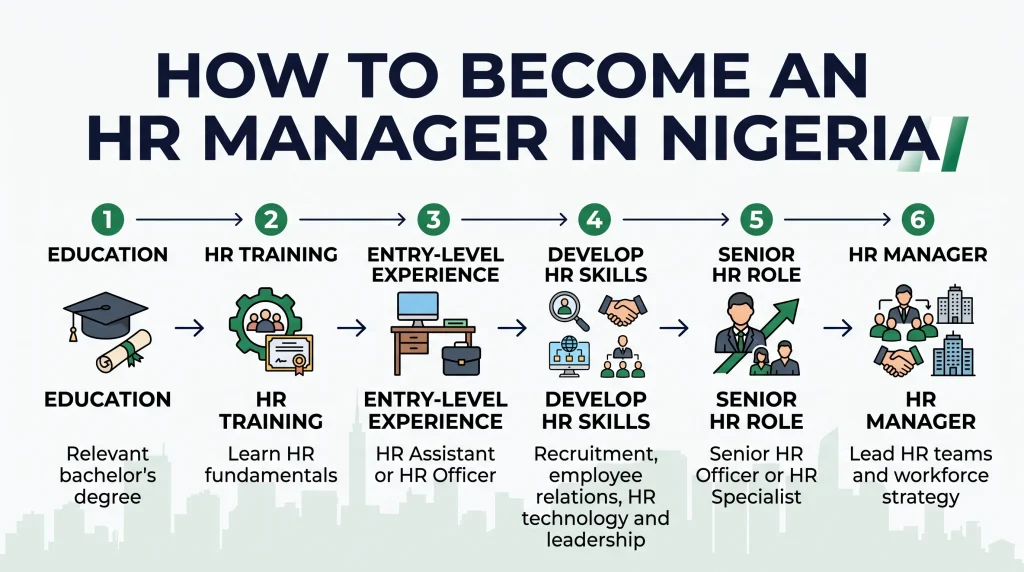
There is no single route that every HR manager must follow. However, a typical career path can look like this:
Education → HR training → Entry-level HR experience → HR specialist/officer role → Senior HR role → HR Manager
Here are the main steps to consider.
Step 1: Get a Relevant Educational Qualification
A bachelor’s degree can provide a useful foundation for an HR career.
Relevant areas of study may include:
However, employers may have different educational requirements depending on the role.
If you already have a degree in another discipline, this does not necessarily prevent you from moving into HR. Additional HR training, professional development and relevant work experience can help you transition into the field.
Step 2: Learn the Fundamentals of Human Resources
Before moving into management, it is important to understand the core principles of HR.
Key areas include:
A structured course can help you develop this foundation, particularly if you are new to HR or transitioning from another career.
Build Your HR Foundation
Develop practical knowledge of recruitment, employee relations, performance management and other essential HR functions to prepare for a career in human resources.
CTA: Enrol in Fundamentals of Human Resources
Step 3: Gain Entry-Level HR Experience
Most people do not move directly from education into an HR manager position.
Entry-level positions can provide the practical experience needed to understand how HR departments operate.
Potential starting positions include:
At this stage, focus on learning how HR processes work in practice.
For example, you might gain experience in:
Step 4: Develop Recruitment and Talent Management Skills
Recruitment is one of the most visible functions of HR, and practical recruitment experience can be valuable for aspiring HR managers.
Learn how to:
You should also understand the broader talent management process, including employee development and retention.
Step 5: Build Employee Relations Skills
HR managers frequently deal with workplace issues involving employees and managers.
Employee relations can involve:
Strong interpersonal skills are particularly important in this area.
An HR manager needs to communicate professionally with people at different levels of an organisation while handling sensitive information appropriately.
Step 6: Understand Nigerian Employment Requirements
Anyone aiming for an HR management position in Nigeria should develop a working understanding of the legal and regulatory environment affecting employment.
Relevant areas may include:
HR managers do not necessarily need to be lawyers, but they should understand when an HR issue may have legal or regulatory implications and when specialist advice may be necessary.
Step 7: Develop Leadership Skills
An HR manager is not simply an HR administrator.
Management responsibilities may include leading an HR team, advising senior management and helping the organisation make workforce decisions.
Important leadership skills include:
Developing these skills early can help you prepare for managerial responsibilities.
Step 8: Learn HR Technology and Data Analysis
Modern HR departments increasingly rely on technology and data.
Depending on the organisation, HR professionals may work with:
You should also understand basic HR metrics.
Examples include:
Being able to interpret HR data can help you move from administrative HR work toward more strategic responsibilities.
Step 9: Consider Professional HR Development
Professional development can strengthen your HR career.
In Nigeria, the Chartered Institute of Personnel Management of Nigeria (CIPM) is the statutory professional body for human resource management practitioners in the country.
Depending on your career stage, professional development through relevant HR programmes and qualifications can help you build structured knowledge and demonstrate commitment to the profession.
However, professional qualifications should complement—not replace—practical HR experience.
Step 10: Progress Into Senior HR Roles
Once you have developed experience across several HR functions, you can begin targeting more senior positions.
A potential progression could be:
|
Career stage |
Example position |
|
Entry level |
HR Intern / HR Assistant |
|
Early career |
HR Administrator / HR Officer |
|
Developing professional |
HR Executive / HR Specialist |
|
Experienced |
Senior HR Officer / HR Specialist |
|
Management |
HR Manager |
|
Senior management |
Senior HR Manager / HR Lead |
|
Executive |
Head of HR / HR Director |
Career progression is not always linear. Some professionals specialise in recruitment, learning and development, compensation and benefits, employee relations or HR business partnering rather than moving directly through generalist HR roles.
How Many Years Does It Take to Become an HR Manager in Nigeria?
There is no universal number of years required.
Some organisations may appoint an HR manager after several years of relevant experience, while larger organisations may expect considerably more experience, particularly for positions involving large teams or complex workforce responsibilities.
A reasonable career-development pathway might involve:
2–4 years: Entry-level and HR officer experience
4–7 years: Senior HR, specialist or supervisory experience
5–10+ years: Potential progression into HR management, depending on the organisation and candidate
These are career-planning ranges rather than formal requirements.
The level of responsibility you have handled can be just as important as the number of years you have worked.
What Skills Do You Need to Become an HR Manager?
Successful HR managers typically need a combination of technical, interpersonal and leadership skills.
Communication Skills
HR managers communicate with employees, managers, executives, candidates and external professionals.
You should be able to explain policies and workplace issues clearly and professionally.
Recruitment Skills
Understanding how to attract, assess and select employees is fundamental to many HR roles.
Employee Relations
HR managers need to handle workplace concerns, grievances, conflicts and sensitive employee situations professionally.
Leadership
Managing an HR team requires delegation, coaching, decision-making and accountability.
Problem-Solving
HR professionals regularly encounter complex workplace problems that require careful analysis and balanced solutions.
Confidentiality
HR departments handle sensitive employee information. Maintaining confidentiality and using information appropriately is therefore essential.
Organisation
HR managers may oversee multiple projects simultaneously, including recruitment, training, performance reviews and employee relations.
Strategic Thinking
At management level, HR increasingly involves connecting workforce decisions with organisational objectives.
What Qualifications Do You Need to Become an HR Manager in Nigeria?
There is no single qualification that guarantees an HR Manager position.
Employers may look for:
Some positions may specify a particular degree or professional qualification, while others place greater emphasis on demonstrated experience.
If your educational background is outside HR, gaining targeted HR training can help fill knowledge gaps.
What Is the Salary of an HR Manager in Nigeria?
HR management salaries vary considerably according to employer, location, experience, industry and level of responsibility.
Glassdoor’s 2026 Nigeria data reports a total-pay range of approximately ₦160,000–₦567,000 per month for Human Resources Managers, with median total pay of about ₦275,000 per month.
A separate 2026 salary benchmark from MaxisHR reports:
|
HR Manager level |
Reported monthly range |
|
Junior HR Manager |
₦250,000–₦420,000 |
|
Mid-level HR Manager |
₦420,000–₦700,000 |
|
Senior HR Manager |
₦700,000–₦1,200,000 |
These figures illustrate the substantial variation in HR salaries. They should be treated as market benchmarks rather than guaranteed salary levels.
Where Do HR Managers Work in Nigeria?
HR managers can work across virtually every major industry.
Potential employers include:
The industry you choose can influence the type of HR work you perform and the skills you need.
HR Generalist vs HR Specialist
Another important career decision is whether to remain a generalist or specialise.
Build Your Human Resources Foundation
Develop practical knowledge of core HR functions and workplace practices to strengthen your foundation and prepare for the next stage of your human resources career.
HR Generalist
An HR generalist works across multiple HR functions.
They may handle:
This route can provide broad experience and may be particularly useful for someone working toward an HR Manager position.
HR Specialist
An HR specialist focuses on a particular area.
Examples include:
Specialisation can allow professionals to develop deep expertise in a particular HR function.
How to Stand Out When Applying for HR Manager Jobs
If you are applying for an HR management position, your CV should demonstrate more than a list of HR duties.
Where possible, show measurable results.
For example, instead of:
Responsible for recruitment.
You could describe measurable achievements such as:
Coordinated recruitment for multiple vacancies and improved candidate turnaround time.
Other achievements you might highlight include:
Quantifiable achievements can help employers understand the impact of your work.
Common Mistakes to Avoid
Trying to Become a Manager Too Quickly
Management positions generally require practical experience. Focus on developing strong HR fundamentals before pursuing management titles.
Ignoring Employee Relations
HR is not only about recruitment. Employee relations and workplace problem-solving are major components of HR management.
Focusing Only on Qualifications
Qualifications are valuable, but employers also need evidence that you can apply HR knowledge in real workplace situations.
Neglecting Technology
HR professionals increasingly work with digital systems and workforce data. Basic technology skills can therefore be valuable.
Failing to Understand Employment Requirements
HR decisions can have legal and compliance implications. Develop a strong understanding of the employment requirements relevant to your organisation.
Is HR Management a Good Career in Nigeria?
HR management can provide career opportunities across many industries because organisations of different sizes need people-management functions.
The career can also lead to several areas of specialisation, including talent acquisition, learning and development, compensation and benefits, employee relations, HR analytics and organisational development.
However, career progression depends on factors such as skills, experience, employer demand, qualifications, performance and the broader labour market.
A Practical Career Roadmap
If you are starting from the beginning, the following roadmap can provide a useful structure:
1. Learn HR fundamentals
Understand recruitment, employee relations, performance management and other core HR functions.
2. Gain practical experience
Look for internships, HR assistant roles, administrative positions or recruitment opportunities.
3. Develop specialist skills
Build expertise in areas such as recruitment, employee relations, HR analytics or learning and development.
4. Take on more responsibility
Volunteer for HR projects and responsibilities that demonstrate leadership and problem-solving.
5. Continue professional development
Consider relevant HR qualifications, training and professional development.
6. Progress into senior HR roles
Build experience managing people, HR processes and workplace projects.
Frequently Asked Questions
How do I become an HR manager in Nigeria?
A typical pathway involves obtaining relevant education or training, gaining practical HR experience, developing specialist and leadership skills, and progressing through roles such as HR Assistant, HR Officer and Senior HR professional before moving into management.
What qualifications do I need to become an HR manager in Nigeria?
Requirements vary between employers. A relevant degree, HR training, professional development, practical experience and strong leadership and communication skills are commonly useful.
How many years does it take to become an HR manager in Nigeria?
There is no fixed timeframe. Many professionals spend several years developing HR experience before moving into management, with some reaching management positions after around five to ten years while others take longer or progress more quickly.
Can I become an HR manager without an HR degree?
Yes, depending on the employer. A degree in business, psychology, management or another relevant field can provide a foundation, while HR-specific training and practical experience can help you transition into HR.
Is CIPM required to become an HR manager in Nigeria?
Professional HR development can strengthen your career, but specific requirements vary by employer and position. CIPM is Nigeria’s statutory professional body for human resource management practitioners, and its qualifications and professional development programmes are relevant to HR careers.
What skills does an HR manager need?
Important skills include communication, employee relations, recruitment, leadership, conflict resolution, problem-solving, organisation, confidentiality, HR technology, and strategic thinking.
How much does an HR manager earn in Nigeria?
Salary varies substantially by employer and experience. Current 2026 sources report figures ranging from approximately ₦160,000 to ₦567,000 monthly in Glassdoor’s total-pay data, while other salary benchmarks report higher ranges for experienced and senior HR managers.
Where can HR managers work in Nigeria?
HR managers can work in banking, technology, telecommunications, manufacturing, oil and gas, healthcare, education, construction, retail, hospitality, professional services, NGOs and many other sectors.
Build Your Human Resources Foundation
Develop practical knowledge of core HR functions and workplace practices to strengthen your foundation and prepare for the next stage of your human resources career.
Final Thoughts
Learning how to become an HR manager in Nigeria involves building a combination of education, practical HR experience, professional knowledge and leadership capability.
A typical route starts with learning HR fundamentals and gaining an entry-level position. From there, you can develop experience across recruitment, employee relations, performance management, training and other HR functions before progressing into senior and managerial roles.
There is no single career path or fixed number of years required. The most important focus is to continually develop practical HR skills, understand the Nigerian employment environment, demonstrate measurable results and gradually take on greater responsibility.